
Requirements to professionally important qualities of firefighters
Ivashchenko Oksana associate professor of the department of foreign languages Cherkasy Institute of Fire Safety named after Chornobyl Heroes of State University of Civil Defense of Ukraine EDUCATION (Problems of specialists’ training)
Ivashchenko Oksana
associate professor of the department of foreign languages
Cherkasy Institute of Fire Safety named after Chornobyl Heroes
of State University of Civil Defense of Ukraine
EDUCATION (Problems of specialists’ training)
Requirements to professionally important qualities of firefighters
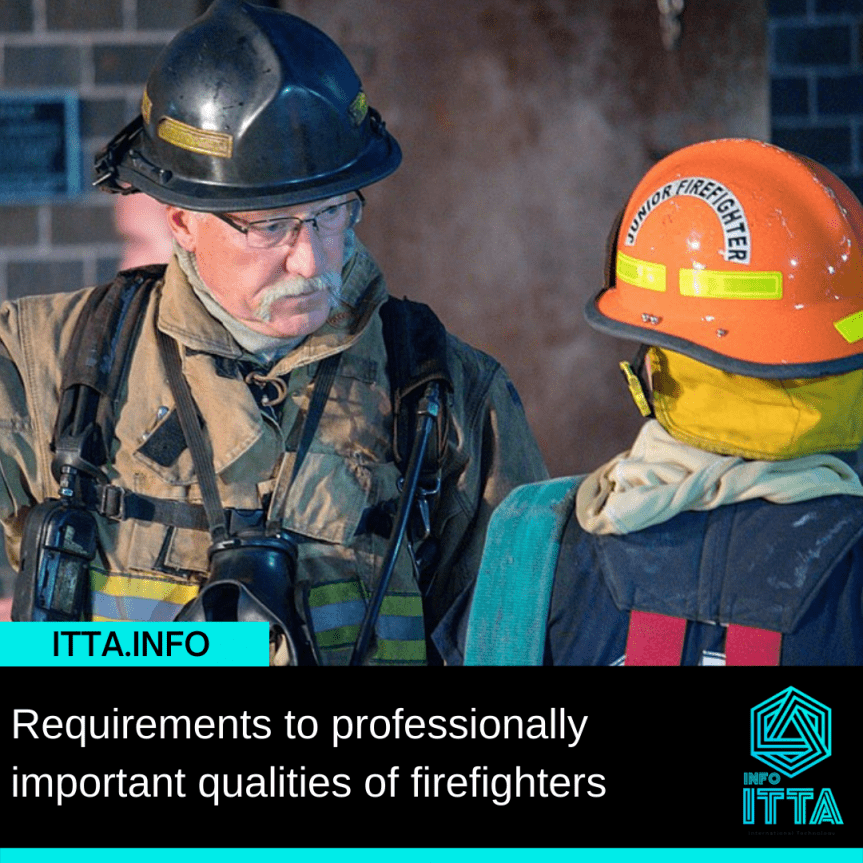
Firefighter is a specific profession that has a number of features, among which are high level of danger, stress, injury, responsibility, risk, uncertainty, actions in a limited space and lack of time.
The activity of the specialist takes place both in normal conditions (prevention of emergencies, fire-technical inspection of objects, research of fires and emergencies), and in extreme conditions – on fires of various categories of complexity, during liquidation of consequences of man-caused accidents, natural disasters, rescue operations. In modern world the work of firefighters has become incomparably more complex, more intense and dangerous, because it involves the use of various technical means, tools and special equipment. Due to the emergence and use of various synthetic, flammable materials, flammable and explosive technologies, the content of the fire and rescue service has also changed significantly.
The work of fire and rescue units is associated with significant physical and mental stress caused by a high degree of personal risk, responsibility for people and the preservation of material values, with the need to make decisions very quickly. In addition, the activity of specialists takes place in extremely unfavorable conditions, characterized by high temperature, the presence of toxic substances in the environment, which requires the use of personal protective equipment. Periodic round-the-clock shifts are a violation of normal sleep. The circumstances mentioned above contribute to the development of fatigue, negative functional states, can be the cause of diseases and injury.
In the process of activity, the specialist constantly interacts with the people who are subordinate to him and to whom he is subordinate, as well as with the victims. Among the structural elements of the specialist's activity we want to single out two most important: 1) team work, which takes place at the fire scene in order to extinguish fires, eliminate the consequences of an accident or natural disaster. It is an organization of firefighting and rescue operations. Its main elements are: assessment of the situation and development of a tactical plan for firefighting or rescue operations, setting tasks for subordinates, guiding them, taking measures to comply with safety rules, communicating with victims, processing documents, reporting to senior officers; 2) educational work, which consists in training and educating subordinates, uniting the team and strengthening discipline, organizing and conducting educational work, implementing the achievements of pedagogy, psychology, sociology. It contributes to the effectiveness of training and requires the development of communication skills – the ability to maintain conversation, to choose the appropriate form of communication depending on the psychological state and individual characteristics of the interlocutor.
The selected elements form a single system of activity of the specialist of fire and rescue service and cause high requirements to professionally important qualities of the firefighter. Significant changes in the content and conditions of activity require from specialists not only physical and professional training, but also the formation of a set of certain psychological and pedagogical professionally important qualities.
References:
1. Бут В. П. Методичні рекомендації по особливостях професійного відбору до оперативно-рятувальної служби цивільного захисту МНС України / В. П. Бут, В. В. Вареник. – Черкаси, 2004. – 133 с.
2. Ковтунович М. Г. Психологическая подготовка спасателей / М. Г. Ковтунович, Н. В. Рожков, С. Н. Ениколопов, Е. В. Орлова. – М., 2007. – 250 с.