
More than half of Ukrainians see a friendly country in Israel - Israel's Ambassador to Ukraine
Exclusive interview of the Ambassador of Israel to Ukraine Michael Brodsky to Interfax-Ukraine on the eve of the 30th anniversary of the establishment of diplomatic relations between the two countries
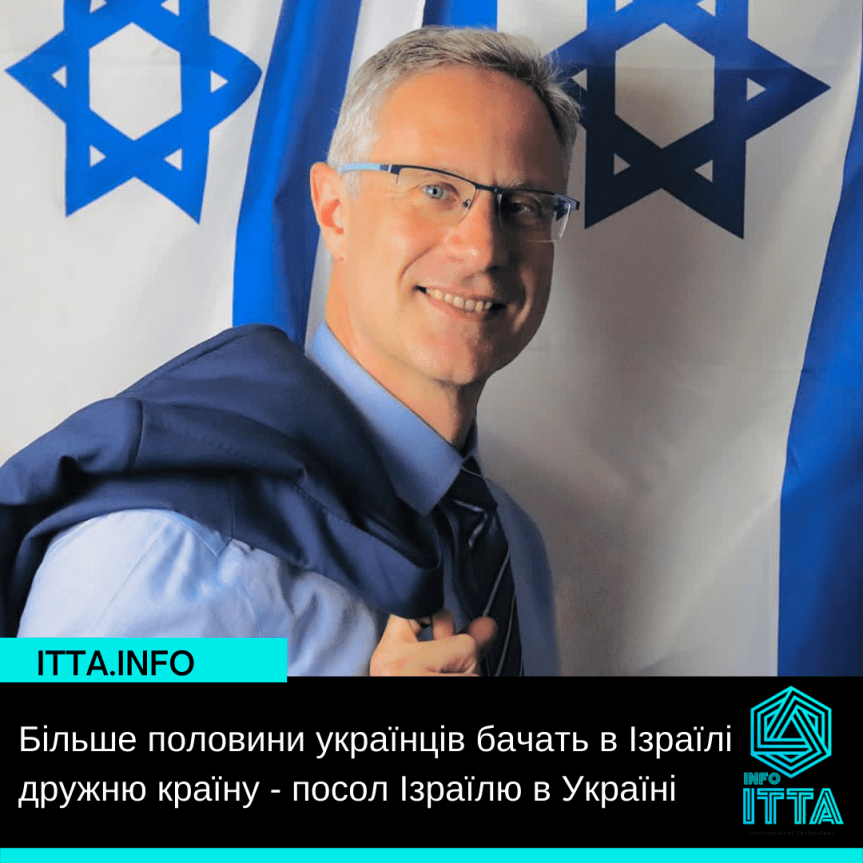
Exclusive interview of the Ambassador of Israel to Ukraine Michael Brodsky to Interfax-Ukraine on the eve of the 30th anniversary of the establishment of diplomatic relations between the two countries
Speaking recently at the Jewish Forum, you called the relations between Ukraine and Israel "family." Usually so characterize the relationship warm and friendly, although disputes in the family are also...
It's exactly as you said. Firstly, it is literally often family relations, because Israel lives half a million people from Ukraine. Here, in Ukraine, a large Jewish community. The exact figures are unknown, but many call 200 thousand people, perhaps even more. And the citizens of our countries, many are really connected by family ties, and if not family, then certainly friendly. Every almost Ukrainian has friends, relatives, acquaintances in Israel, so this is not a formal relationship. This is not just a relationship between two countries, which have some common interests, in the economy, in politics. This relationship is certainly first of all personal, so I call them family.
But as you correctly said, there are different situations in the family, and this does not mean that we look at all things completely the same. But I think we have a lot more in common than what separates us, and a lot of things we see in a similar way.
Moreover, I can say that, like any relatives, we are in many ways similar. Maybe even more so than it seems at first glance. First of all, we are similar in our desire for independence, we are similar in that we must defend our independence often with weapons in hand. We are similar in that we are willing to sacrifice in the name of preserving democracy and freedom of speech. And we're like our political culture.
I think about this very often since I came to Ukraine four months ago, that our political culture is similar in many ways, and maybe on the part of people inexperienced it seems quite strange, maybe unmanageable, maybe chaotic. In fact, this freedom of thought and this constant discussion on the sharpest questions - and is the basis of our power.
Those who live in other societies may not understand this. We in Israel understand this well, because this is our main trump card, if you like, our "secret weapon." Thanks to this free discussion, as a result, we become stronger both internally and externally.
This is very important for the citizens of Ukraine, many of whom believe that a free discussion turns the country into chaos. Israel shows that this is not the case.
Israel shows that it is possible to preserve freedom of speech, it is possible to preserve democracy, all political freedoms, while being in a difficult situation in terms of security. More specifically - in a state of permanent war with neighbors, continuing to fight terror.
In Ukraine, there is an opinion that the restriction of freedom of speech during war is normal, since freedom can "work" on the enemy. How is this done in Israel?
At different stages there were different approaches. There is an institution in Israel called military censorship. It is said that some information of a military or, say, strategic nature can be sensitive, and can help Israel's enemies, for example, achieve their goals. Therefore, there is military censorship, which checks for state secrets information, which is of particular value.
But this does not mean that even in the most difficult of times, even during wartime, there are significant restrictions on freedom of speech or public discussion. Always, in any situation in Israel, freedom of speech was preserved, except for these specific cases, which I am talking about.
The theme of antisemitism in Ukraine. Recently, the embassy appealed to law enforcement officers in connection with the manifestation of antisemitism in Kiev and the Dnieper during the celebration of Hanukkah. Are you satisfied with the reaction of Ukrainian law enforcement officers?
We know that those guilty of this incident were arrested in Dnipro. We would like the law to be applied to them, which was recently adopted (the Law on Prevention and Counteraction to Antisemitism in Ukraine "was adopted by the Verkhovna Rada on September 22, 2021 - IF-U) We would like these crimes to be classified according to the new article of the law, which just determines what crimes are on the ground of antisemitism, as opposed to bullying or other.
Until that happened. We are monitoring this situation. We would like this law not just to be formal, not just a declaration, but to be an effective weapon in the fight against antisemitism, because precedent is needed. That no one will have the desire and incentive to show it, because he will have to pay for it by imprisonment
And in general, do you think this is a real or far-fetched problem in Ukraine?
Antisemitism exists in Ukraine just as it exists in most countries. I do not think that in this sense the situation in Ukraine is worse or better than in other countries. I see positive changes in the state's attitude to this problem, and probably the most important step is this law that was passed. This is a law that was highly appreciated in Israel, it is important to us.
But I think that for Ukraine, it is definitely not less important, because it involves the adoption of a universal definition of antisemitism. Thus, Ukraine becomes part of the family of Western peoples, who, in the main, have already adopted this definition, and for Ukraine it is a step towards the civilized world.
You recently met with the director of the Institute of National Memory Anton Drobovich. Did you understand his logic, he understood your logic? As you know, probably the issues of national memory have recently been very acute in Ukraine.
I think we understood each other. This does not mean that we must agree on all matters. We have, let's say, open questions about historical memory that we don't agree on. We talk about it openly, we talk at meetings of different levels, including at meetings at the highest level between presidents, which was not so long ago, and we talk about it publicly.
About the economy. Are you satisfied with how the free trade zone between Ukraine and Israel works? When will the service sector be added to this agreement?
The agreement came into force only on January 1 of this year. Too little time has passed, it is early to assess its results, especially since the year has fallen on the pandemic, and this has greatly complicated trade between the two countries.
We have a very big potential to increase trade volume. Today, it's about 700 million a year - it's not much. I think that we can easily, without making very serious efforts, reach a billion, or even more, due to the fact that there is a huge potential for increasing the export of Ukrainian products to Israel. First of all, food, it's agricultural various foods, much more, raw materials, possibly building materials, can be very much everything. Goods for which duties have been reduced or canceled altogether. This makes trade between our countries much more profitable.
On the other hand, Ukraine can buy Israeli technologies to a greater extent than it does today. Today we have an imbalance of trade relations - Israel buys much more in Ukraine than Ukraine buys in Israel. Therefore, we want to see how this agreement will work. By the logic of things, it should lead to an increase in trade volumes in the near future, if the coronavirus does not badly spoil our plans.
As for the service agreement, we fundamentally agreed to start negotiations on a new agreement next year. Negotiations are not usually a matter of weeks or months, it is a matter of several years, so I would not expect an immediate outcome.
And what is included in the concept of "service sector"?
This will just be the subject of negotiations, because this is not a universal agreement. Countries agree on what services we will extend to, say, the mode of greatest assistance, a softer tax burden and so on.
I think first of all we will talk about financial services and IT related services. The IT sector is one of the main areas of cooperation between Israel and Ukraine in recent years, because more than half of the outsourcing of Israeli high-tech today falls on Ukraine. Today, 30 works here in Ukraine, there may be 40 thousand programmers for Israeli companies. That is, imagine that each of these programmers on average earns $3-4 thousand per month at least, or even much more. But if you take even the minimum wages, it turns out that 30-40 thousand times $3 thousand is the Israeli contribution to the economy of Ukraine, the contribution of Israeli companies. On the other hand, this is a Ukrainian contribution to the economy of our country, because Israel is catastrophically lacking programmers.
Israeli high-tech is a locomotive of our economy. State treasury revenues from high-tech are one of the most serious components of the Israeli state budget today. Therefore, if there are such people in Ukraine who can help Israeli companies to perform their tasks, then this is great. This brings our countries closer together, and this is a completely mutually beneficial situation.
Recently, the Ukrainian-Israeli Investment Summit was held in Kyiv. You listened to both Ukrainian and Israeli businessmen. Did you find any new touch points or was it just a conversation about intentions?
In addition to intentions, we have reality. And in reality we have a lot of investments, Israeli, first of all...
In real estate
Yes, in real estate. These are really thousands of Israelis, maybe even tens of thousands who buy real estate here in Ukraine, there are Israeli developers who work in the Ukrainian market very successfully. This is ours today one of the main directions in terms of Israeli investments.
Are these basically our former citizens?
Not necessarily. These are indigenous Israelis who just see the economic effect of investment in Ukrainian real estate, because today in the Ukrainian market you can get income from renting an apartment in the amount of 8-9%, maybe even 10% per annum - this is what can not be obtained today in Israel or most European countries. Therefore, Ukraine is a very attractive market in this sense. Someone is probably buying for himself. Someone buys apartments in Odessa and comes to Odessa by sea in the summer.
In addition, there are many interesting projects already implemented or planned in the field of medicine. In Kiev there is a famous Israeli hospital - LISOD. There are several other projects that we are trying to help. Now we are discussing this with the Ministry of Health.
Cooperation in the field of irrigation is discussed for a long time
There are several Israeli companies, first of all Netafim, which work in the Ukrainian market quite successfully, and there are projects and sales of Israeli technologies in the field of drip irrigation. First of all, it is the south of Ukraine - Mykolaiv, Kherson, possibly Odessa region.
Now this issue is especially acute in Ukraine, because the consequences of global warming are already felt. And we hear here, including from the Ministry of Agriculture, that in the coming years there will be a lack of water for agriculture in the south of the country.
Israel, probably like no other, knows and knows how to solve this problem, because Israel is a country with a very dry climate, where there are traditionally not enough sources of fresh water. We have managed to solve this problem in various ways, first of all, economical use of water, drip irrigation, mass desalination of water. Today this problem in Israel is solved. Moreover, we solve similar problems in other countries and we will gladly help Ukraine to cope with this problem.
Recently, representatives of several Israeli companies visited, they left for the regions, and we hope that there will be a continuation, because the topic is relevant for both countries. On the part of Ukraine, we feel interested, the president talked about it when he met our president here.
Cooperation in the field of cybersecurity. I understand that this issue is quite closed...
I know that such cooperation is, there is great interest from both state structures in Ukraine and private structures in the Israeli experience. There are many Israeli companies that are trying to work here. There are contacts, there are projects, and the potential here is very great, because there is probably no equal today in the field of security of Israel. This is one of the strategic directions - along with agriculture, irrigation and medicine.
What do you advise potential Israeli investors? What risks do you tell them?
I beware of giving advice to investors. The risks associated with investments in Ukraine are well known.
Judicial system?
First of all, of course, the judicial system. It's a fear of losing investment. Fear that you will not be able to protect your investments in court, that there will be no transparency, there will be no honest and adequate attitude. Therefore, these are quite logical reasons why many Israeli investors are afraid to invest in Ukraine.
On the other hand, there are positive changes, including, for example, in the field of IT. I think that after the adoption of the law on "Action. City "new investments can come to Ukraine. We are already talking about the deeper participation of Israeli capital, Israeli companies in the IT market in Ukraine, because there are prerequisites for this. And now, together with the entry into force of Dia.City, a legislative and tax framework is being created. Therefore, I think this direction today is very promising.
There is always an opportunity to work within a public-private partnership and many Israeli companies would like to work in this format. Question: Is Ukraine ready to give state guarantees for investments to go here without fear?
No bank will give money without serious guarantees, and the issue of financing is the main thing.
A few years ago, we have worsened relations in the field of tourism due to the refusal of entry into Israel to some Ukrainian citizens. Ukraine even for some time restricted entry into the country of citizens of Israel. Has this problem survived now?
At this moment there is no tourism - no problem (laughs). Now, when we talk to you, Israel is closed to foreign tourists, unfortunately.
But it will open one way or another.
I really hope that Ukrainian tourists return to Israel. At the peak about 200 thousand tourists from Ukraine came to us - quite a lot and we welcome it.
We do not welcome illegal workers who tried to get under the guise of tourists to Israel. It was quite a massive phenomenon. And only this was caused by situations where people were deployed, sent back or long figured out the purpose of coming to Israel. Indeed, I can not disagree with you, unfortunately, often tourists who really came with tourist goals, fell under this situation, when it was not always possible to set the exact purpose of the arrival, and therefore on the eve of the coronavirus crisis, we were able to agree on the format, as we solve this issue.
We agreed that we will have representatives of the border service: Ukrainian - in Israel, at Ben-Gurion airport, our service - here in Boryspil. We agreed on various mechanisms for sharing information, on cooperation between the police, when it will be possible to detect in advance who is leaving illegally, and already stop it before boarding the plane, not after arrival.
All these things were frozen due to the onset of the coronavirus pandemic. I am sure that after the coronavirus crisis is over, we will be able to return to fulfilling these agreements, see how we can solve this problem. But, unfortunately, I can not guarantee that the situation will not happen again, because if people go again for the purpose of working illegally in Israel, then, unfortunately, tourists will suffer from it.
How would you rate the level of cooperation with the Ukrainian authorities during the celebration of Rosh Hashanah this year? Is this your first experience?
This is generally the first experience when Hasidim massively come in a coronavirus situation. Last year, as you remember, they are generally stuck on the border with Belarus. This year, fortunately, everything went more or less smoothly. More or less - this does not mean that there were no incidents, because they happen every year.
There was a situation where Israeli law required PCR tests before departure, before returning to Israel, and representatives of the Israeli Ministry of Health came here to conduct such checks. Because, unfortunately, in Ukraine, the fake PCR tests are quite common, it is not a secret. We wanted to prevent infected people from entering Israel, so additional checks were carried out by our Ministry of Health.
This does not mean that by next year we will not need to prepare carefully, because there are many questions, there are many unsolved problems in Uman itself, and we are ready to connect to this issue.
But we must not forget that the responsibility lies with the Ukrainian authorities, and how this event itself passes is, first of all, a question to the government of Ukraine. Our tourists are here on the territory of Ukraine, they must comply with all laws, but on the other hand, we would like to have the most friendly attitude to them, as befits any other tourist. We believe that the Ukrainian side has done its utmost to ensure safety and to ensure the health of both pilgrims and locals. We hope that next year everything will be even better.
Prospects for contacts at the highest level are there?
There were several telephone conversations between President Zelensky and Premier Bennet. They even met briefly in Glasgow at a climate summit. And in principle, we are discussing the possibility of President Zelensky's visit to Israel, and, in theory, I do not exclude Prime Minister Bennet's visit to Ukraine. But while there are no specific dates for both visits.
30 years have passed since the establishment of diplomatic relations between our countries. What would you like to see for the next 30 years?
Give God, that in 30 years we will achieve the same result, the same progress as we have made in the past 30 years. Indeed, there is tremendous progress in all areas. There is still a potential that we have not used, first of all, in economics and business.
In terms of political contacts and understanding, I think we have achieved a very good level of understanding. This applies to bilateral relations, concerns cooperation in international organizations, the United Nations.
As for culture, I think it is difficult to find closer peoples and more close cultures than Ukrainian and Israeli ones. And thanks to the active actions of embassies - both our embassy here and the embassy of Ukraine in Israel - today our peoples learn more and more about each other.
We have a great flight service: several flights every day, several airlines that operate these flights. In principle, everything is very good in our relationship. And indeed, we perceive Ukraine as a friendly country.
On the eve of the 30th anniversary, we conducted a public opinion poll here in Ukraine, and found that more than half of Ukrainians see a friendly country in Israel, namely 55%. At the same time, only 17% - do not consider Israel a friendly country, and the rest either have no opinion, or they refrained from answering. But this only proves what we basically knew and so: that Ukraine in relation to Israel is a friendly country. I think that the Israelis feel the same feelings about Ukraine.